
Contact us
Call +971 50 547 7393 or WhatsApp +971 50 271 5650 with your location and the pest you are seeing. We will confirm the earliest available slot, including same-day where possible.
Wiping an ant trail removes the surface foragers and leaves the nest untouched. As an approved pest control company in Dubai, CG Pest Control Dubai uses slow-acting baiting matrices and residual barriers that destroy the entire colony, including the queen and brood, across villas, apartments, and commercial facilities.
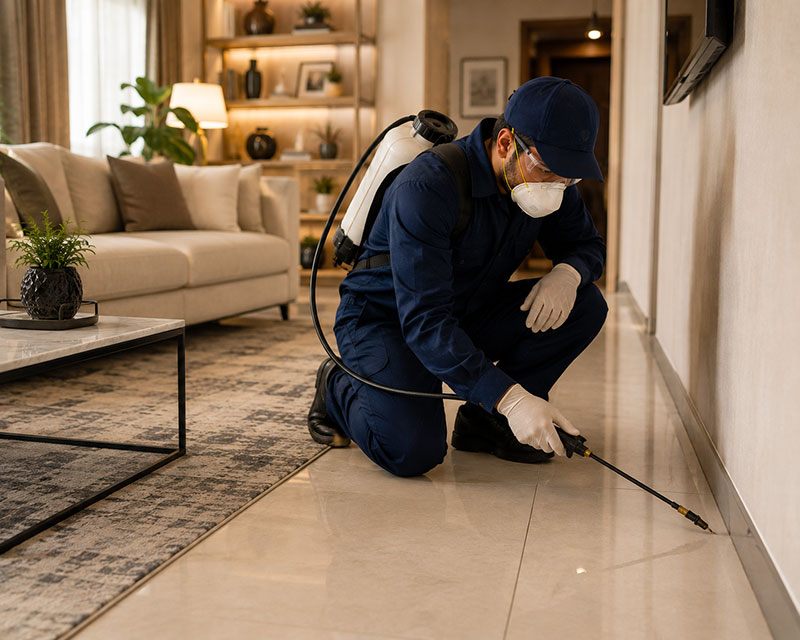
The ants crossing your worktop or floor are merely foragers representing less than 10% of the active colony. The queen and brood nest deep inside wall voids, under floor tiles, behind kitchen cabinets, or within outdoor landscaping. Effective ants control in Dubai requires delivering targeted treatment directly to the reproductive core of the colony, which surface aerosol sprays or detergents can never achieve.
As a leading provider of pest control Dubai services, we deploy species-specific gel and granular baits. Foraging workers ingest the bait and transport it back into the subterranean or wall-cavity nest, sharing it through trophallaxis with the queen and larvae. This systemic chain reaction achieves total colony extermination. For broader residential protection, explore our residential pest control in Dubai and Termite Control Dubai treatments.
Crucial note on ant spraying: Common UAE ant species (such as Pharaoh ants, crazy ants, and ghost ants) respond to repellent chemical sprays by budding — triggering the single colony to split into multiple satellite nests across your property. Our certified technicians prevent budding by using non-repellent, undetectable formulations tailored for homes and businesses across Dubai Marina, Arabian Ranches, JVC, Palm Jumeirah, and Downtown Dubai.
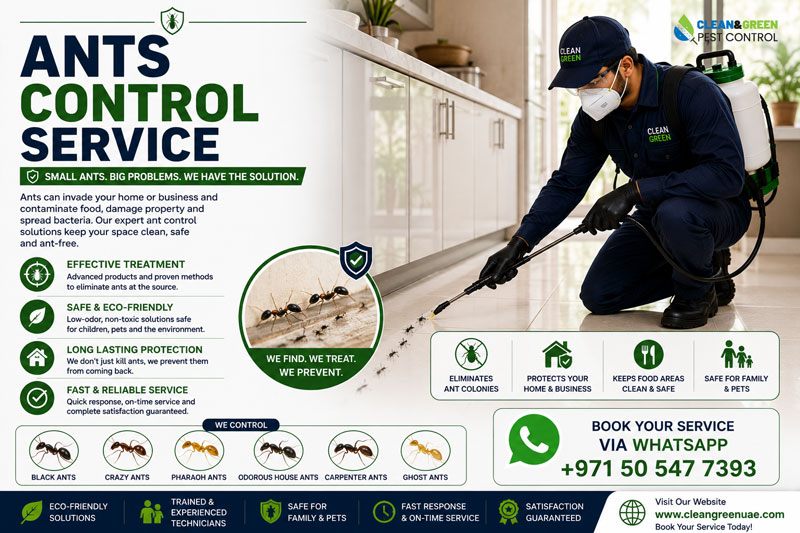
From kitchen Pharaoh ants to garden black ants and carpenter ants, targeted species identification ensures 100% elimination.
Why trails reappear, what actually reaches the nest, and when to call rather than wait.
Booking ant control in Dubai takes a couple of minutes — call or WhatsApp +971 50 547 7393, or use the form on this page. If you can, send a photo of the ants and the trail; species identification from a clear photo often lets us bring the right bait on the first visit.
One request before we arrive: leave the trail in place. It looks counter-intuitive, but an active trail shows the technician exactly where the foragers are travelling and where the nest is likely to be. Cleaning it away removes the single most useful piece of evidence.
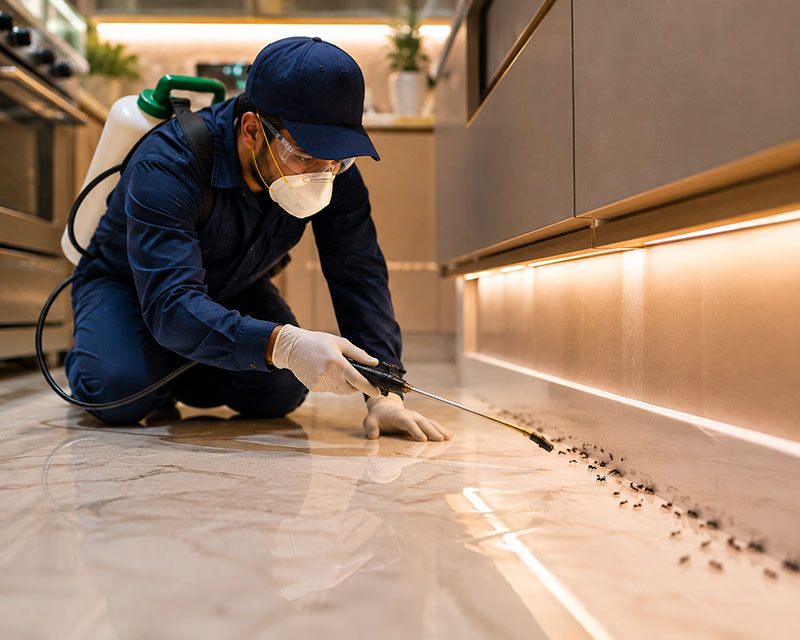
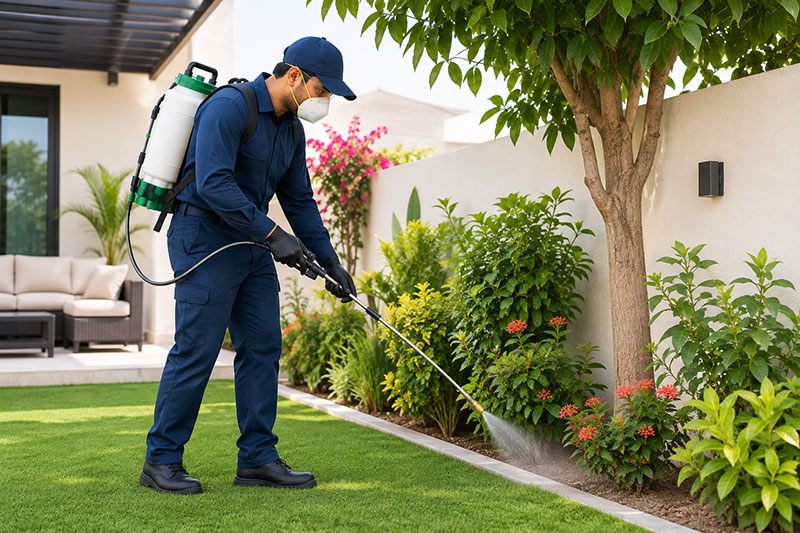
Our technicians cover all Dubai communities — including Arabian Ranches, Palm Jumeirah, Jumeirah, JVC, Dubai Marina, Downtown Dubai, and Mirdif. Ant pressure in Dubai is highest where irrigated landscaping meets a building — villa gardens, planters against boundary walls, and the soft ground around AC condensate drainage.
Knowing the local species matters. The small pale ants that appear around bathroom sinks behave very differently from the larger black ants trailing in from a garden bed, and they take different baits. Bringing the wrong bait means a wasted visit for you and a return trip for us.
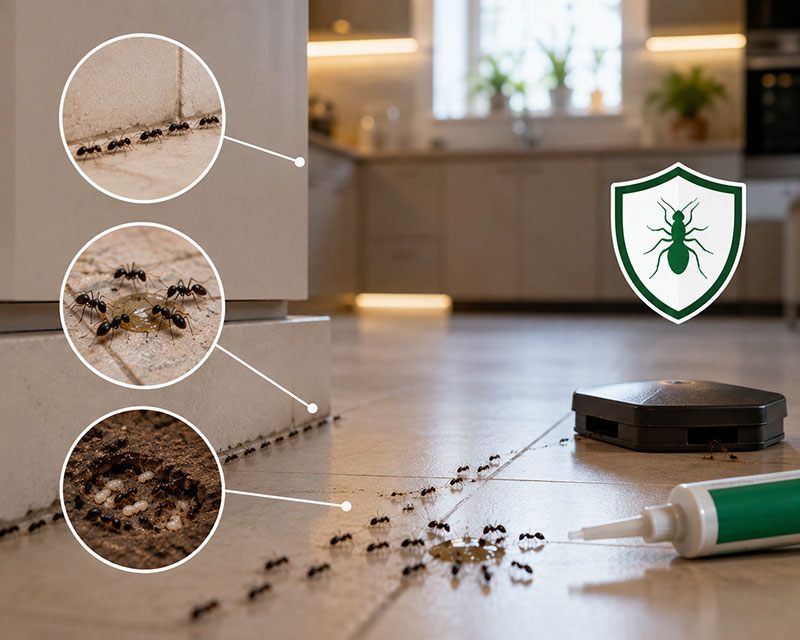
We identify the species before choosing a product, because ant baits are not interchangeable — some colonies want sugars, others want proteins or fats, and the preference can even shift seasonally. Matching the bait is the difference between a colony that takes it back to the queen and one that ignores it entirely.
We also avoid repellent sprays indoors precisely because they can cause colony budding. Where a barrier is useful we apply it externally, at the perimeter, so ants are stopped before entering rather than split into several nests inside your walls.
Ant colonies grow steadily and, once mature, produce winged reproductives that fly off to establish new nests nearby. Seeing winged ants indoors is a sign the colony has reached that stage — and that a single problem is about to become several.
For food businesses in Dubai there is a compliance angle as well: visible ant activity in a preparation area is a straightforward inspection failure. Treating a young colony takes one visit; clearing several mature satellite nests across a building takes considerably more.
Four straightforward steps from your first call to lasting protection.
Call +971 50 547 7393 or WhatsApp +971 50 271 5650 with your location and the pest you are seeing. We will confirm the earliest available slot, including same-day where possible.
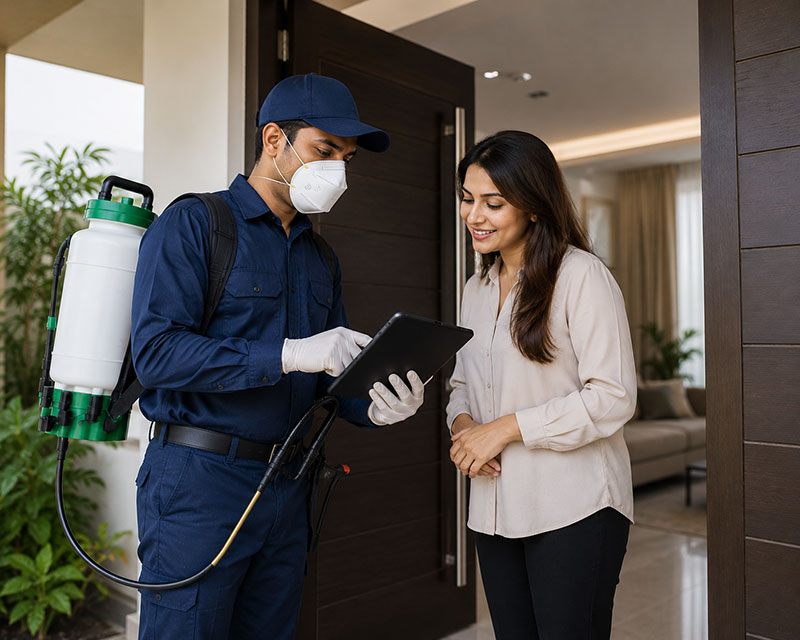
A technician identifies the species, traces the nest or harbourage, and checks entry points and moisture sources — then issues a fixed written quote.
We apply the right method for the pest and setting — gel baits, sprays, dusting or soil barriers — and seal the gaps that let them in.
We verify the result, return for follow-up visits where the pest requires it, and set up ongoing prevention so the problem does not come back.
Because the trail is not the colony. Wiping it removes the pheromone path and the foragers currently on it, but the queen and brood are untouched and simply send more workers out. Only a bait that foragers carry back into the nest affects the part of the colony that reproduces.
That is normal and a good sign. Gel bait attracts foragers, so activity around the bait points increases for a few days as workers feed and recruit others. Numbers then fall away sharply as the bait reaches the nest. Do not clean the bait away during this phase — it is doing exactly what it should.
Usually one to two weeks for full colony control. Baits are deliberately slow-acting so workers survive long enough to share the treatment with the queen and larvae — a fast knockdown would kill the foragers before they made it home, leaving the nest intact.
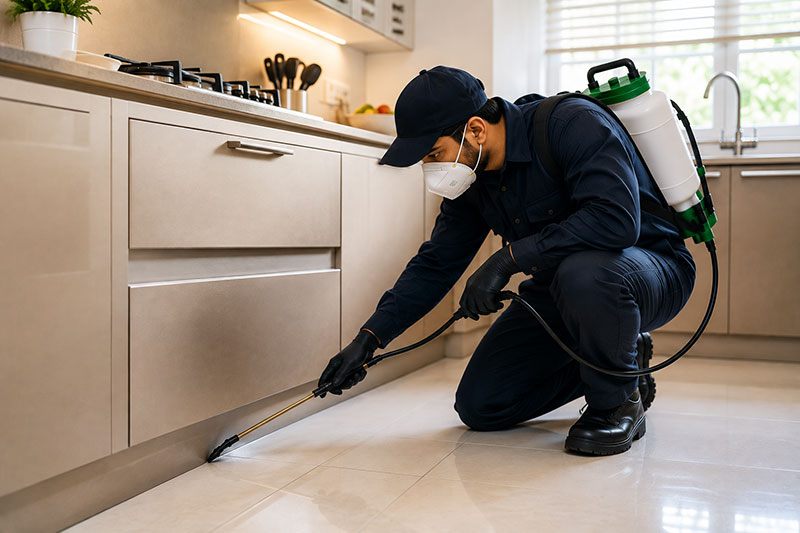
Yes. Bait is placed in tiny quantities into cracks, crevices and concealed points — behind kickboards, along cabinet edges, inside voids — never on open surfaces where food is prepared. Fully organic options are available for homes with infants or pets; mention it when booking.
Yes — for garden-sourced colonies we treat the external perimeter and, where the nest can be located in a planter, irrigation box or garden bed, treat it directly. Villas in Dubai with irrigated landscaping usually benefit from a seasonal perimeter treatment as part of an annual contract, since the outdoor population is continually replenished.
Fill in your details and our team will confirm your appointment shortly.
We have received your request and will respond within a few hours.